

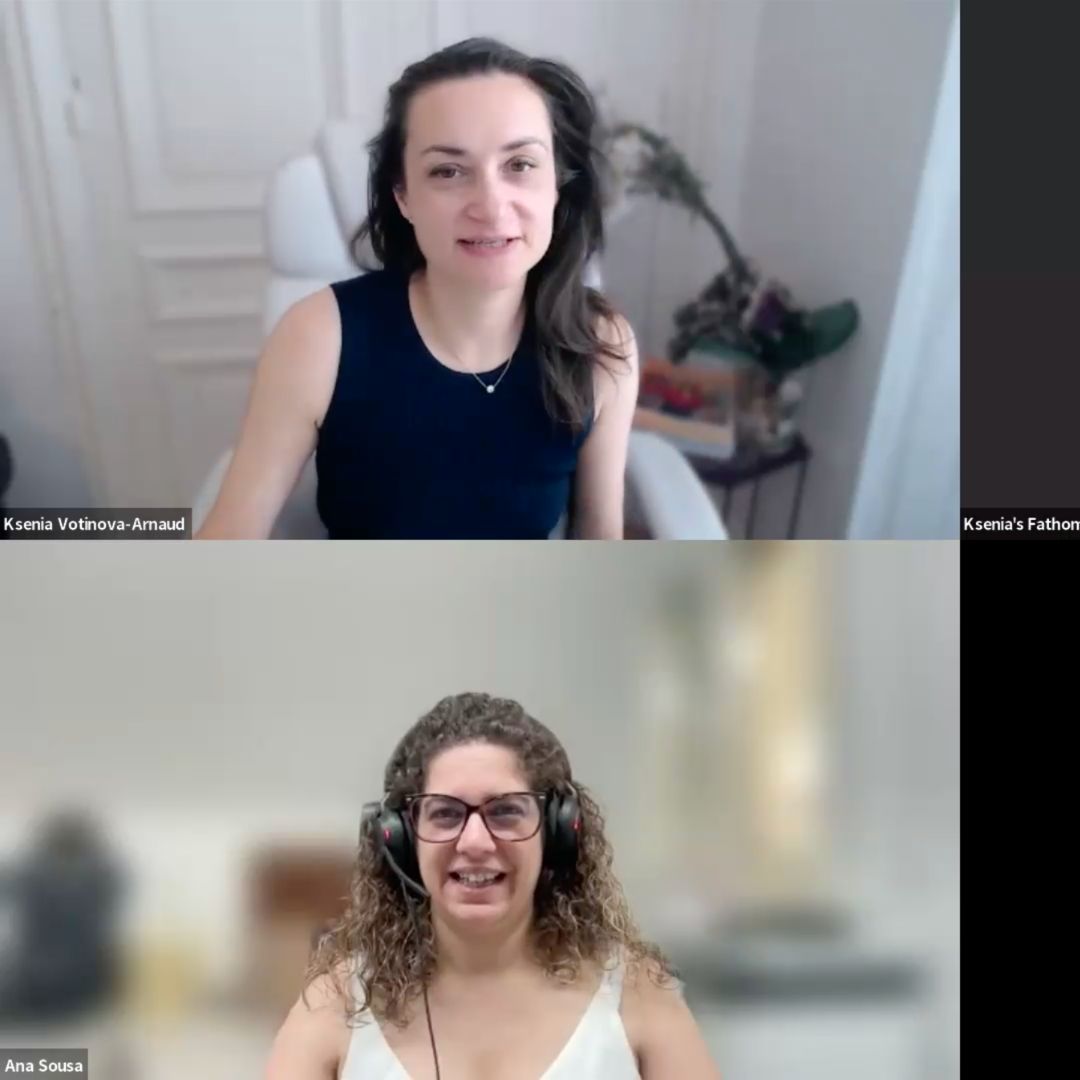






The Notification That Was Waiting at 6.30 in the Morning
Ana opened her laptop on a Thursday in July. Someone had paid at 6.30 that morning, before she was even awake.
“I woke up and they had paid at 6.30 a.m. It was the first thing I saw when I got to my computer. Celebration time!”
Her first paying customer. She had not graduated yet. She was in week seven of eight.
I ran two Launchpad cohorts this year, the April intake and the June intake, and for part of June they overlapped. Two rooms of women trying to validate a business idea while working full time.
What came out of those two rooms is the most useful thing I have to show you this year. Not the tidy version. The real numbers, including the ones that went backwards, and the sentences the women themselves said out loud on the calls.
I want to show you three of them. Then I want to show you what those eight weeks changed about the programme itself.
Ana: Thirty-One Raised Hands, Before Graduation
Ana Sousa spent fourteen years in tech in Portugal. Developer first, then QA, then QA leadership. She joined the June cohort to build practical AI training in Portuguese.
Her first idea was Portuguese real estate agents. She killed it after two interviews.
Then the market pulled the offer out of her. Colleagues and connections kept asking the same thing: how do you actually build AI agents and apps. So she asked them straight. “I’m thinking of building a course around this. Would you sign up?”
Seven said yes. She collected the emails from direct pitches.
Then she built the whole launch in one week. Landing page, offer, community, pre-work materials, payments, email automation. The same week she signed a contract for a new full-time role.
Her course is called Claude Code na Prática. Four days live. Participants build, test, secure and publish two real web apps, with no coding background required.
By the end of the programme:
→ 3 paying customers
→ 28 people on the waitlist
→ a full class agreed for September, colleagues from one company, terms still being negotiated
→ a consultancy that asked her to run the same training for their non-technical staff
That last one happened by accident. One of the consultancies she works with announced they were rolling out Claude Code Pro to everyone. She replied to say she happened to teach it, and asked how to get access.
“I just did it without thinking. And what happened was they actually said, you know what, we want you to come and give that training for us as well.”
Her readiness scorecard went from 40 to 90. Her clarity on who she was serving went from 14 to 100.
Here is what she said to the rest of the room, and it is the line I keep coming back to:
“If you’re in the right headspace and you keep your project in the back of your mind, the validation finds you. Sometimes it’s just a real conversation that goes somewhere you didn’t expect. Don’t lose hope. Keep pushing. It pays through.”
I said something back to her on an earlier call that I will repeat here, because the word luck came up. It is not only luck. It is action. She talked to enough people that she was standing in front of the opportunity when it arrived.
Her company is Crialia. She built it around a full-time job, and started a new one halfway through.
Fane: “I’m Not a People Person”
Fane came into the June cohort with a mission she believed in and a wall in front of it. She is a visionary by instinct, technical by training, and she did not want to talk to strangers.
She told me so directly, more than once. Here is how she described her own starting point on our final call:
“I remember when I was sharing my frustrations that I’m not a people person to go to conduct interviews, and that I don’t feel confident to seek for potential customers without having some POC first.”
She also believed she needed money before she could have a team, and a team before she could have a product.
What changed was not her personality. It was who she was talking to.
Once she aimed her interviews at the people she was actually building for, AI developers, the whole thing stopped being an ordeal.
“I have interviewed a lot of people and it was easy. It was pleasant, because it was in my comfort zone. They were also tech people and we understand each other perfectly and we see alignment in our why.”
Then she did something braver. She needed a three-person team for an open-source hackathon, so she posted on LinkedIn, laid out six project ideas and asked for people. The post passed 100K impressions in a few days. Dozens of AI developers volunteered.
“I don’t need to raise funds first and hire a team. I already have a team.”
Her clarity on customer landed at 75%, up from a standing start. But the number is not the story. The story is that a woman who told me she was not a people person ran more than ten interviews and then built a team out of a single post.
One more detail, because it says something about what these cohorts become. When I thanked her, she redirected it. “Thank you, Ana, because you have made it possible with your repost.”
They had been in the same room for eight weeks. One amplified the other. Neither of them was asked to.
The Result That Looks Like a Setback
Most weeks do not end with a payment notification or a viral post. Most weeks look like this.
One woman in the April intake had been circling her idea for years. In her own words:
“It was only through this program, when I was given a deadline, that I got into action. I finally did it.”
She ran thirteen customer interviews. Then she sent her offer to all thirteen. Four came back with hard feedback. Price resistance. Confusion about the format.
I would call that her most valuable week of the eight.
She ran a second round of interviews, the first she had ever done, and rebuilt the offer as a lower-priced retainer with add-ons. Two of the original thirteen turned genuinely warm. One asked her, unprompted, whether she could just pay an ongoing fee to keep the work going.
Another member spent that cohort trying to reach physicians and could not. Too busy, and so used to phishing attempts that a message from a stranger reads as a threat. She could have called that a failed eight weeks. She treated it as data and moved to physician assistants and residents, who are reachable.
Her clarity on customer went from single digits to the mid sixties. Her score on her own why went down, and when we talked about it she was plainly discouraged.
I keep both numbers. A score that drops while you are rebuilding your offer is not a bad week. It is the only honest way to measure the work.
Killing an idea in week two costs you two interviews. Killing it in year two costs you two years.
The Programme Keeps Changing, Because They Keep Telling Me What Is Missing
Mona graduated from an earlier cohort. She is a Global VP of Sales, not an engineer, and she wanted an app for her community for over a year. She could not code. Hiring a developer was out of budget. She eventually built Strong Again herself in Lovable, describing what she wanted and iterating until it worked.
Then she did something I did not expect. She came back and bought a place in a bonus training at a more recent intake of the Weatherproof Business Launchpad, because that intake had a No-Code MVP Sprint and hers had not. The bonus did not exist when she went through.
While she was inside that sprint, she applied to SheBuilds by Lovable and spent forty-eight hours building a second app from scratch.
That is the pattern I want you to see. She did not come back for motivation. She came back for a specific thing the programme had added since she left.
Almost everything in the Launchpad now exists because somebody in a cohort hit a wall and said so out loud. The sprint. The mastermind calls. The office hours that carry on for months after the last session.
The same thing happened with AI. Three problems kept surfacing in both rooms this year:
→ A member selling into a non-English-speaking market kept getting a UK persona back, because no prompt carried her market.
→ If you ask an AI to research your customer in the same thread where you already described her, it agrees with you instead of researching.
→ Research came back confident and unsourced, with no way to tell which claims were real.
None of those are prompt-writing problems. They are context problems, so that is what we changed. Market and selling language are now captured at the start and carried into every prompt. Research prompts open in a fresh session and end by asking for a source and a confidence level on every claim. Then a human check you run yourself.
And one line stays in bold through the validation weeks: AI cannot be your customer. It writes your interview script. It helps you find people. It makes sense of what you heard. It does not have the conversation. When producing an offer costs almost nothing, the only scarce thing left is evidence that someone will pay for it.
From the September intake, all of this gets a home. It is called Roadmap OS. One weekly view showing the three tasks that matter, tracked against targets you set yourself instead of a number I invented. Unfinished work stays open and is labelled carry over, normal. Nothing turns red. Nothing locks you out of the week your cohort is on.
For graduates there is a second layer, Launch OS, which picks up the day after the programme ends and structures the first hundred days towards a first paying client.
I am not writing code and I have not hired an engineering team. It is Airtable and Lovable, with AI doing the heavy lifting on design and build, which is exactly what I spend eight weeks teaching my members to do. It felt absurd to teach women to build with no-code and AI while paying someone else to build my own product.
None of these changes came from a whiteboard. They came from an independent audit of the June cohort, run by someone who went through the programme as a participant. Every change fixes something a real member hit.
Proof Before Passion
Two cohorts, eight weeks each. One woman finished with thirty-one raised hands. One finished with a team she did not have to pay for. One finished with a dead idea and a live one, which is also a result.
Every one of them did it around a job.
As Ana put it after the last call: “Really grateful for everything the programme has given me. It’s genuinely what made all of this possible.”
The September 2026 intake starts on 28 September and enrolment closes on 21 September. Before that, I sit down with women who have a specific idea, are serious about building it in the next six months, and can give it five hours a week.
I took a month off with my children this summer, but I’m now back and my calendar is open for these conversations. They are free. If that is where you are, book one and we will look at your idea properly.


